ONLINE CATALOGS

Latest Activity

Showing posts with label Belgium. Show all posts

Wednesday, December 19, 2012

Belgium: Flemish Brabant - Politics


Politics

The Governor is the representative or "commissioner" of the Federal and the Flemish Government in Flemish Brabant. He is appointed by the Flemish Government, on the unanimous advice of the Federal Council of Ministers. The current Governor is Lodewijk De Witte, he has been the Governor of Flemish Brabant since it was created in 1995 as a result of the splitting up of the Province of Brabant. The Governor is responsible for supervising the local authorities, ensuring that laws and decrees are observed, maintaining public order and security, and coordinating the response to a disaster which has occurred in his province. He also presides over the Permanent Deputation, however, he doesn't have the right to vote in the Permanent Deputation except in those cases where the Permanent Deputation exercises a judicial function.
Flemish Brabant is that only province that has a Deputy Governor as well. The Deputy Governor is appointed by the Flemish Government on the unanimous advice of the Federal Council of Ministers and must have a considerable knowledge of both the Dutch and the French language. He is responsible for ensuring that the language legislation is observed in the peripheral municipalities of Flemish Brabant.
The Provincial Council of Flemish Brabant consists of 84 members elected for a term of office of 6 years. The last election was held on Sunday 8 October 2006. Six political parties have seats in the Provincial Council: Christian Democratic and Flemish/New-Flemish Alliance (CD&V/N-VA, 25 seats), Open Flemish Liberals and Democrats (Open VLD, 17 seats), Vlaams Belang (15 seats), Socialist Party – Different-Spirit(SP.A-Spirit, 14 seats), Groen! (7 seats) and Union des Francophones (6 seats). The majority in the Provincial Council is currently formed by CD&V/N-VA, Open VLD and SP.A-Spirit. These three parties together have a majority of 56 out of 84 seats.
The current President of the Provincial Council is Vic Laureys (CD&V/N-VA). He is assisted by a Bureau which consists of two Vice-Presidents, four Secretaries, three Quaestors and the floor leaders of the fractions in the Provincial Council.
The Permanent Deputation is the executive organ responsible for the daily administration of the province. It consists of the Governor and six Deputies elected by the Provincial Council from among its midst. The Deputies are currently divided among the majority parties as follows: two for CD&V/N-VA, two for Open VLD and two for SP.A-Spirit. However, one of the two SP.A-Spirit mandates is a shared one, it will be held by a member of SP.A-Spirit for the first three years and from 2009 to 2012 it will be held by a member of CD&V/N-VA.

Belgium: Flag of Flemish Brabant

Belgium: Flag of Flemish Brabant


Flemish Brabant  is a province of Flanders, one of the three regions of Belgium. It borders on (clockwise from the North) the Belgian provinces of AntwerpLimburgLiègeWalloon BrabantHainaut and East Flanders. Flemish Brabant also surrounds the Brussels-Capital Region. Its capital is Leuven. It has an area of 2,106 km² which is divided into two administrative districts (arrondissementen in Dutch) containing 65 municipalities.
Flemish Brabant was created in 1995 by the splitting of the former province of Brabant into three parts: two new provinces, Flemish Brabant and Walloon Brabant; and the Brussels-Capital Region, which no longer belongs to any province. The split was made to accommodate the eventual division of Belgium in three regions (Flanders, Wallonia and the Brussels-Capital Region).
It is a province with a rich cultural history and a great diversity of typical products, among them several of the world-famous Belgian beers.
The province is made up of two arrondissements. The Halle-Vilvoorde Arrondissement has Brussels in its middle. It is therefore mainly a residential area, but it also has large industrial zones. For example, it is home to Belgium's main airport. The other arrondissement is the Leuven Arrondissement, centered on Leuven.
The official language in Flemish Brabant is Dutch (as it is in the whole of Flanders), but a few municipalities are to a certain extent allowed to use French to communicate with their citizens; these are called themunicipalities with language facilities. Other such special municipalities can be found along the border between Flanders and Wallonia, and between Wallonia and the German-speaking area of Belgium. Halle-Vilvoorde mostly surrounds Brussels, which is officially bilingual but whose inhabitants mostly speak French.
The history of Brabant can be found at the Duchy of Brabant article; see also Duke of Brabant.

Belgium: The Economy Of Antwerp


Economy

The Port of Antwerp is the economic heart of the province. Until the agricultural crisis of 1880, the eastern part of the province was a largely agricultural region. The industrial development of the eastern part of the province, part of the Campine region, started at the end of the 19th century when industry established itself in the region. The availability of cheap labor, new roads, canals, tramways and railroads such as the Iron Rhine, stimulated the settlement of new industry. Brick making industry alongside the canals, paper and printing business in Turnhout. Non-ferrous metallurgy in Balen-Nete, dynamite factories in Arendonk and Balen. Tobacco and cigar factories in Arendonk and the first shoe factory in Herentals. During the 1920s, the industrial expansion of the region continued with the radium and copper factories in Olen, the glass factory in Mol-Gompel and the diamond industry in Grobbendonk and Nijlen.
In the 20th century the first nuclear installation in Belgium was established at the SCK•CEN in Mol in 1962. The European Institute for Reference Materials and Measurements (IRMM), one of the EU Joint Research Centres, was founded in Geel in 1957 as a result of the Treaty of RomeInnotek is a technology centre located in Geel and is part of the European Business and Innovation Centre Network (EBN). Industry in the Campine region of the province is mainly located alongside the E313, the E34 and theAlbert Canal.
Chemical industry
After World War II the Port of Antwerp was expanded and on its premises several chemical factories and oil refineries were established, such as BayerBASFMonsanto Company. The chemical and petrochemical industry is widely represented in the port region and comprises the world's second largest cluster of petrochemical industry, next to Houston (USA). In 1967 Amoco Chemical Belgium N.V., now BP, was founded in Geel.
Pharmaceutical industry was founded in Beerse in the 1960s, with Janssen Pharmaceutica and more recently with Genzyme in GeelSoudal (silicon) in Turnhout and Ravago (plastics) in Arendonk became leading companies in their markets.

Diamond

The diamond industry and trade is traditionally located in Antwerp. At the end of the 19th century Hendrik Cassiers founded a diamond cutting company outside Antwerp, in Grobbendonk. Hendrik Cassiers and Frans Dela Montagne laid the foundations of the diamond industry in the Campine region. The industry would settle in NijlenHerenthoutBevelKesselVorselaar and Berlaar.
Paper
The region around Turnhout became famous for its printing business, with companies such as Brepols, which roots date back to 1796 when Pieter Corbeels established his printing business in Turnhout. In 1833, Van Genechten N.V., Splichal N.V. in 1856, Mesmaekers Freres in 1859, Meses-Goris in 1872, L. Biermans in 1875, Poupaert in 1881, La Belgica N.V. in 1907, H. Proost & Co in 1913, J. Van Mierlo-Proost in 1918, Lityca in 1932 and Veloutex in 1951. More recently in 1970, Cartamundi was established, a world leader in playing cards.
Metallurgies
While Wallonia was famous for its steel industry, the Campine region became renowned for its non ferrous metallurgies. The Campine region was scarcely populated in the 19th century and with the availability of canals, the Iron Rhine and cheap labor, severalmetallurgies were established in the region. In 1888-1889 the metallurgy La Vieille Montagne was founded in Balen-Nete, close the Iron Rhine and the canal to Beverlo. The company had its roots in the exploitation of the zinc mines of Moresnet.
The Union Minière du Haut Katanga founded the Société Générale Métallurgique de Hoboken in Olen, which was established along the Iron Rhine and the Albert Canal. The factory produced radiumcobalt and copper from the mines of the Union Minière inKatangaBelgian Congo and Rhodesia. Along the canal Turnhout-Schoten the Métallurgique de la Campine was established in 1910 for the production of lead and antimony. In 1919 La Metallo-Chimique was established which specialized in the production of copper.
Glass
In 1872 the Sablières et Carrières Réunies (SCR), now Sibelco, was founded to extract the silica sand layers in Mol for industrial applications (glass). In 1920 the glass bottle manufacture Beles Réunios was set up in Mol-Donk. In 1921 a group of Belgian banks, the Mutuelle Mobilière & Immobilière, the Société Générale de Belgique, the Banque de Bruxelles and the Financière de Transport together with the American group Libbey-Owens founded the Cie Internationale pour la fabrication mécanique de Verre inMol Gompel. In 1931, due to the economic crisis, the company merged into Glaces et Verres (Glaver). In 1961 Glaver would merge with Univerbel into Glaverbel.
Dynamite
As the Campine region was sparsely populated several dynamite factories were established in the region. In 1875, the Societe Anonyme d'Arendonk was established which premises would later become part of Ravago. In 1881 La Forcite N.V. was established near Balen, which was later acquired in 1920 by the Poudreries Réunies de Belgique (PRB). In 1887 a factory was founded near Herentals, which was closed due to the vicinity to the city. The factories produced explosives for the mines and quarries. The factories in the province are now closed down.

Textile

Historically, wool processing industry was based on the wool from the sheep which were kept on the Campine heath. The centre of the textile industry in the province could be found in Turnhout. Wool processing companies such as Wolspinnerij Van Iersel,Spinnerij en Weverij Van Hoof and De Wollendekensfabriek Van Doren were located in Mol.

Tobacco

At the end of the 19th century Arendonk became the centre of the tobacco industry. Additional factories were founded in TurnhoutMolGeel and Herentals. After World War II, the ALTO sigar factory was founded by Frans Van den Bergh who would also play an important role at Janssen Pharmaceutica.


Antwerp: Traffic Infrastructure


Traffic infrastructure

The province has a network of roads, railroads, canals and rivers which provide a modern infrastructure. Historically, the traffic infrastructure was an important element of connecting the Port of Antwerp with the Ruhr Area in North Rhine-WestphaliaGermany. Both the Iron Rhine railroad and the E313 (King Baudouin highway) and E34 highway connect Antwerp with the Ruhr Area.
The river Schelde, an important waterway, connects the Port of Antwerp with the North Sea. The Albert Canal connects the Scheldt in Antwerp with the Meuse and Liège. Other canals are the Canal Dessel – KwaadmechelenSchoten – Turnhout – Dessel, andHerentals – Bocholt which flows into the Nete canal.
Of the International E-road network, the E313E19, and E34 run through parts of the province. The Kennedy Tunnel and the Liefkenshoek Tunnel connect the highway network of the province with East Flanders and Ghent. In addition a newOosterweelconnection is under consideration.
The railroads connect the major cites of the province, such as AntwerpMechelenHerentalsTurnhout and Mol. The Iron Rhine connects Antwerp with Mönchengladbach in Germany. The new High Speed Train connects Antwerpen-Centraal railway station withBrussels (HSL 4) and Amsterdam (HSL-Zuid) at high speed. Antwerp International Airport, located in Deurne is a regional airport.

Belgium: Antwerp - Coat Of Arms

Belgium: Antwerp - Coat Of Arms

Belgium: History Of Antwerp

Location Of Antwerp On Map Of Belgium

History

During the early Middle Ages the region was part of the Frankish Empire, which was divided into several pagi. The territory of the present day province belonged to several pagi of which the region around Antwerp belonged to the Pagus Renesium. The Pagus Toxandria stretched from North Brabant into the Campine region. To the south there was the Pagus Bracbatinse and the Pagus Hasbaniensis. In 843 the Carolingian Empire of Charlemagne was divided among his sons and the river Scheldt became the border between West Francia and East Francia. In 974 Otto II established the Margraviate of Antwerp as a defence against the County of Flanders.
In 1106, Henry V granted the Margraviate to Godfrey I of Leuven. His descendants would from 1235 onwards become the Dukes of Brabant and the region itself was the northern part of the Duchy of Brabant. In 1430 the Duchy became part of the County of Burgundy until 1477 when it fell to the House of Habsburg. In 1713, at the end of the Spanish Succession War the region became part of the Austrian Netherlands until 1794, with in 1790 the short lived United States of Belgium. On 1 October 1795 the former Austrian Netherlands were annexed by France under the French Directory.
The modern province was created as the Department of the two Netes during the First French Empire (when the Southern Netherlands were part of France). After the defeat of Napoleon, the territory became part of the United Kingdom of the Netherlands as the province of Antwerp. In 1830, after the Belgian Revolution the province kept its name.

Prefects from 1800 until 1814

Prefects of the Department of the two Netes during the First French Empire

Governors from 1815 until 1830

Governors of the province of Antwerp during the United Kingdom of the Netherlands

Governors since 1830

Governors of the Belgian province of Antwerp

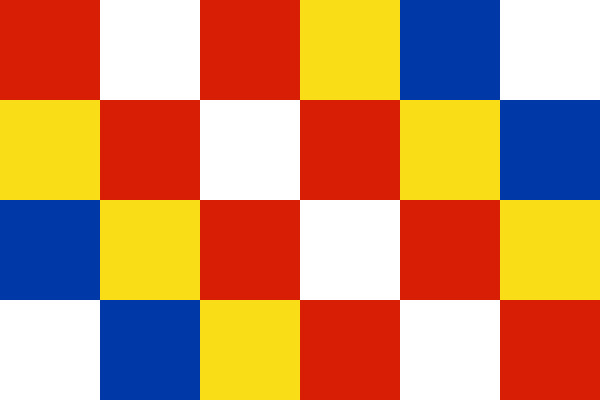
Belgium: Flag of Antwerp

Belgium: Flag of Antwerp


Antwerp  is the northernmost province both of the Flemish Region, also called Flanders, and of Belgium. It borders on (clockwise from the North) North Brabant province of theNetherlands and the Belgian provinces of LimburgFlemish Brabant and East Flanders. Its capital is Antwerp which comprises the Port of Antwerp. It has an area of 2867 km² and with nearly 1.7 million inhabitants it is the country's most populous province. The province consists of 3 Arrondissements, Antwerp, Mechelen and Turnhout. The eastern part of the province comprises the main part of the Campineregion.