ONLINE CATALOGS

Latest Activity

Showing posts with label EU. Show all posts

Wednesday, December 19, 2012

Tobacco products: towards bigger health warnings and ban of strong flavourings


Tobacco products: towards bigger health warnings and ban of strong flavourings
Today, after years in the making, the European Commission has adopted its proposal to revise the Tobacco Products Directive. The proposed legislation consists of new and strengthened rules on how tobacco products can be manufactured, presented, and sold. More specifically, it bans the use of cigarettes, roll-your-own tobacco (RYO) and smokeless tobacco products with characterising flavours and makes the use of large pictorial health warnings mandatory on cigarettes and RYO. It regulates cross border internet sale and foresees technical features to combat illicit trade. Moreover, measures are proposed for products that were not specifically regulated so far such as e-cigarettes and herbal products for smoking. Chewing and nasal tobacco will be subject to specific labelling and ingredient regulations. The existing ban for oral tobacco (snus) shall be maintained.
On the occasion of the proposal's adoption, Commissioner in charge of Health & Consumer Policy, Tonio Borg said: "We delivered! The European Commission had promised a proposal on tobacco products by the end of 2012, and that's what I'm presenting today to Health ministers and the European Parliament. The figures speak for themselves : tobacco kills half of its users and is highly addictive. With 70% of the smokers starting before the age of 18, the ambition of today's proposal is to make tobacco products and smoking less attractive and thus discourage tobacco initiation among young people". He added that"Consumers must not be cheated: tobacco products should look and taste like tobacco products and this proposal ensures that attractive packaging and flavourings are not used as a marketing strategy."
Why a revision of EU law?
The current Tobacco Products Directive (2001/37/EC) dates from 2001. Since then, significant scientific, market and international developments have taken place. For example, new evidence on flavourings used in tobacco products and effectiveness of health warnings has become available. Novel products such as electronic cigarettes have entered the market and recent marketing strategies involve the use of attractive packaging and flavours. At international level, the EU and all of its Member States have ratified the WHO Framework Convention on Tobacco Control (FCTC) which entered into force in February 2005. As a consequence, some of the current provisions of the Directive have become outdated. Member States have also taken different regulatory approaches resulting in a divergence between Member States' laws on the manufacture, presentation and sale of tobacco products.
The new proposal is responding to these developments and to requests from the European Parliament and the Council of Ministers as well as the Commission's own report on the Application of the Tobacco Products Directive of 2007 and 2009, which identified potential areas for improvement.
Main elements of the proposal:
The proposal foresees major revisions of the current Directive. It addresses in particular the following areas:
  • Labelling and Packaging: All cigarette and Roll Your Own packages must contain a combined picture and text health warning covering 75% of the front and the back of the package and must carry no promotional elements. The current information on tar, nicotine and carbon monoxide, which is perceived as misleading, is replaced by an information message on the side of the pack that tobacco smoke contains more than 70 substances causing cancer. Member States remain free to introduce plain packaging in duly justified cases.
  • Ingredients: An electronic reporting format for ingredients and emissions will be introduced. The proposal foresees a prohibition for cigarettes, roll your own tobacco and smokeless tobacco that have characterising flavours and a prohibition of products with increased toxicity and addictiveness.
  • Smokeless tobacco: The ban on oral tobacco products (snus) is maintained, except for Sweden which has an exemption. All smokeless tobacco products must carry health warnings on the main surfaces of the package and products with characterising flavours cannot be sold. Novel tobacco products require prior notification.
  • Extension of the scope of the Directive : Nicotine Containing Products (e.g. electronic cigarettes) below a certain nicotine threshold are allowed on the market, but must feature health warnings; above this threshold such products are only allowed if authorised as medicinal products, like nicotine replacement therapies. Herbal cigarettes will have to carry health warnings.
  • Cross border distance sales: A notification for internet retailers and age verification mechanism are foreseen to ensure that tobacco products are not sold to children and adolescents.
  • Illicit trade: A tracking and tracing system and security features (e.g. holograms) are foreseen to ensure that only products complying with the Directive are sold in the EU.
Process and Timelines
The proposal has been adopted following extensive consultation of stakeholders including a public consultation which generated 85,000 responses. During its preparation, a thorough impact assessment has been carried out, evaluating economic, social and health effects of several policy options under consideration. Several external studies were commissioned during the process.
As a next step, the proposal will be discussed in the European Parliament and in the Council of Ministers. It is expected to be adopted in 2014. It would come into effect from 2015-2016.

Belgium: Flemish Brabant - Politics


Politics

The Governor is the representative or "commissioner" of the Federal and the Flemish Government in Flemish Brabant. He is appointed by the Flemish Government, on the unanimous advice of the Federal Council of Ministers. The current Governor is Lodewijk De Witte, he has been the Governor of Flemish Brabant since it was created in 1995 as a result of the splitting up of the Province of Brabant. The Governor is responsible for supervising the local authorities, ensuring that laws and decrees are observed, maintaining public order and security, and coordinating the response to a disaster which has occurred in his province. He also presides over the Permanent Deputation, however, he doesn't have the right to vote in the Permanent Deputation except in those cases where the Permanent Deputation exercises a judicial function.
Flemish Brabant is that only province that has a Deputy Governor as well. The Deputy Governor is appointed by the Flemish Government on the unanimous advice of the Federal Council of Ministers and must have a considerable knowledge of both the Dutch and the French language. He is responsible for ensuring that the language legislation is observed in the peripheral municipalities of Flemish Brabant.
The Provincial Council of Flemish Brabant consists of 84 members elected for a term of office of 6 years. The last election was held on Sunday 8 October 2006. Six political parties have seats in the Provincial Council: Christian Democratic and Flemish/New-Flemish Alliance (CD&V/N-VA, 25 seats), Open Flemish Liberals and Democrats (Open VLD, 17 seats), Vlaams Belang (15 seats), Socialist Party – Different-Spirit(SP.A-Spirit, 14 seats), Groen! (7 seats) and Union des Francophones (6 seats). The majority in the Provincial Council is currently formed by CD&V/N-VA, Open VLD and SP.A-Spirit. These three parties together have a majority of 56 out of 84 seats.
The current President of the Provincial Council is Vic Laureys (CD&V/N-VA). He is assisted by a Bureau which consists of two Vice-Presidents, four Secretaries, three Quaestors and the floor leaders of the fractions in the Provincial Council.
The Permanent Deputation is the executive organ responsible for the daily administration of the province. It consists of the Governor and six Deputies elected by the Provincial Council from among its midst. The Deputies are currently divided among the majority parties as follows: two for CD&V/N-VA, two for Open VLD and two for SP.A-Spirit. However, one of the two SP.A-Spirit mandates is a shared one, it will be held by a member of SP.A-Spirit for the first three years and from 2009 to 2012 it will be held by a member of CD&V/N-VA.

Belgium: Flag of Flemish Brabant

Belgium: Flag of Flemish Brabant


Flemish Brabant  is a province of Flanders, one of the three regions of Belgium. It borders on (clockwise from the North) the Belgian provinces of AntwerpLimburgLiègeWalloon BrabantHainaut and East Flanders. Flemish Brabant also surrounds the Brussels-Capital Region. Its capital is Leuven. It has an area of 2,106 km² which is divided into two administrative districts (arrondissementen in Dutch) containing 65 municipalities.
Flemish Brabant was created in 1995 by the splitting of the former province of Brabant into three parts: two new provinces, Flemish Brabant and Walloon Brabant; and the Brussels-Capital Region, which no longer belongs to any province. The split was made to accommodate the eventual division of Belgium in three regions (Flanders, Wallonia and the Brussels-Capital Region).
It is a province with a rich cultural history and a great diversity of typical products, among them several of the world-famous Belgian beers.
The province is made up of two arrondissements. The Halle-Vilvoorde Arrondissement has Brussels in its middle. It is therefore mainly a residential area, but it also has large industrial zones. For example, it is home to Belgium's main airport. The other arrondissement is the Leuven Arrondissement, centered on Leuven.
The official language in Flemish Brabant is Dutch (as it is in the whole of Flanders), but a few municipalities are to a certain extent allowed to use French to communicate with their citizens; these are called themunicipalities with language facilities. Other such special municipalities can be found along the border between Flanders and Wallonia, and between Wallonia and the German-speaking area of Belgium. Halle-Vilvoorde mostly surrounds Brussels, which is officially bilingual but whose inhabitants mostly speak French.
The history of Brabant can be found at the Duchy of Brabant article; see also Duke of Brabant.

Belgium: History Of Antwerp

Location Of Antwerp On Map Of Belgium

History

During the early Middle Ages the region was part of the Frankish Empire, which was divided into several pagi. The territory of the present day province belonged to several pagi of which the region around Antwerp belonged to the Pagus Renesium. The Pagus Toxandria stretched from North Brabant into the Campine region. To the south there was the Pagus Bracbatinse and the Pagus Hasbaniensis. In 843 the Carolingian Empire of Charlemagne was divided among his sons and the river Scheldt became the border between West Francia and East Francia. In 974 Otto II established the Margraviate of Antwerp as a defence against the County of Flanders.
In 1106, Henry V granted the Margraviate to Godfrey I of Leuven. His descendants would from 1235 onwards become the Dukes of Brabant and the region itself was the northern part of the Duchy of Brabant. In 1430 the Duchy became part of the County of Burgundy until 1477 when it fell to the House of Habsburg. In 1713, at the end of the Spanish Succession War the region became part of the Austrian Netherlands until 1794, with in 1790 the short lived United States of Belgium. On 1 October 1795 the former Austrian Netherlands were annexed by France under the French Directory.
The modern province was created as the Department of the two Netes during the First French Empire (when the Southern Netherlands were part of France). After the defeat of Napoleon, the territory became part of the United Kingdom of the Netherlands as the province of Antwerp. In 1830, after the Belgian Revolution the province kept its name.

Prefects from 1800 until 1814

Prefects of the Department of the two Netes during the First French Empire

Governors from 1815 until 1830

Governors of the province of Antwerp during the United Kingdom of the Netherlands

Governors since 1830

Governors of the Belgian province of Antwerp

Flag: The Belgian Senate building is one of the few to use the official national flag in the 13:15 ratio.

Flag: The Belgian Senate building is one of the few to use the official national flag in the 13:15 ratio.
The Belgian Senate building is one of the few to use the official national flag in the 13:15 ratio.


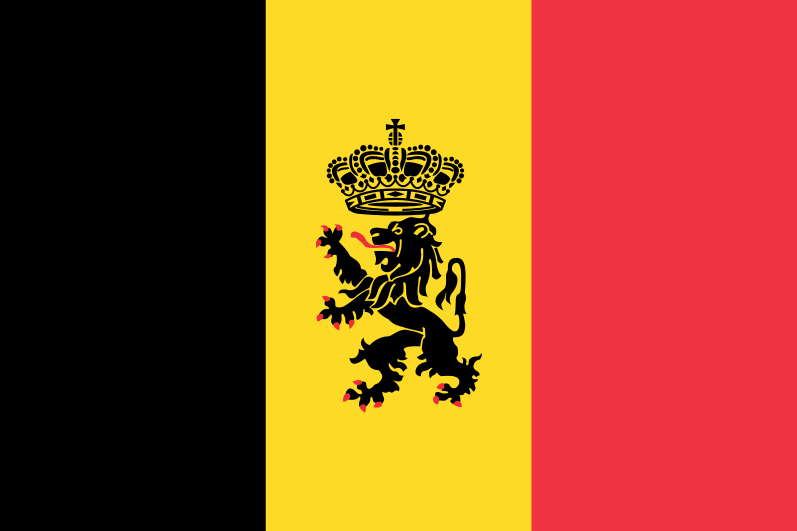
Government Ensign of Belgium

Government Ensign of Belgium